Buying a Home in Charlotte, TN: What to Know About Rural Living and Homeownership
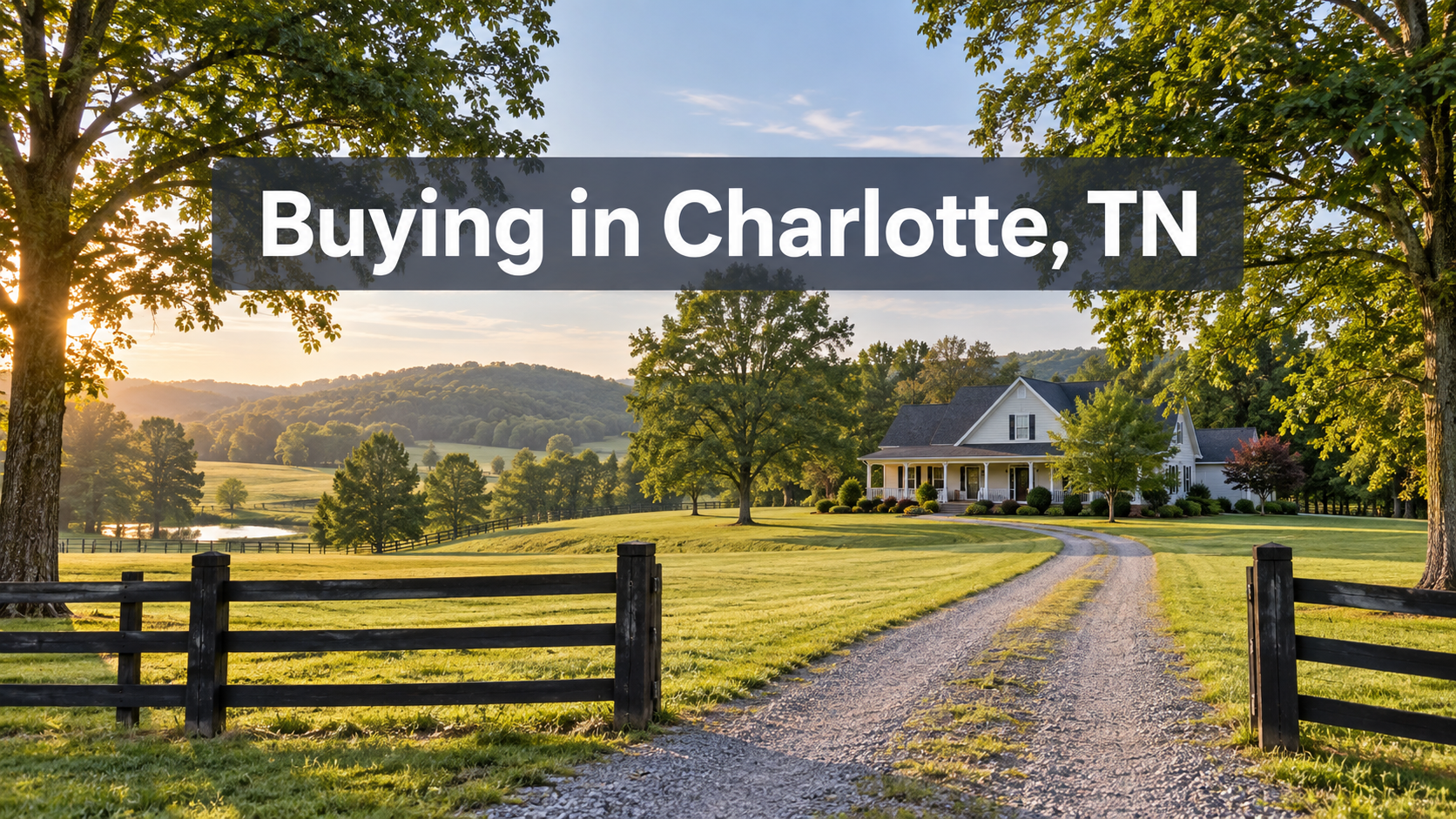
Buying a home in Charlotte, TN can be a smart way to get a more relaxed Dickson County setting without giving up access to Dickson and the Nashville region. The tradeoff is that buyers need to investigate the property itself more carefully. Roads, internet, utilities, septic capacity, drainage, topography, and drive time can vary from one address to the next.
Last updated: September 19, 2026
This guide covers Charlotte and nearby parts of Dickson County, not every property carrying a Charlotte mailing address. I’m Harley Pope with Pope Real Estate Group at The Baker Brokerage. I’m a lifelong Middle Tennessee local, and I help buyers translate a listing’s acreage, location, and features into the way the property will actually function on an ordinary week.
Buying a home in Charlotte, TN: what buyers should understand
Charlotte is the county seat of Dickson County and has a distinctly small-town and rural context. Some properties are close to the courthouse area, while others with a Charlotte address feel much farther out. That range is part of the appeal, but it makes address-level due diligence essential.
The best starting point is the Charlotte community guide and the broader Dickson County guide. Those pages help place the community inside the county before you compare individual homes. If you are still deciding among nearby towns, review Charlotte versus Dickson comparison and the practical guide to buying a home in Dickson.
For a closer property-level comparison, use the Charlotte TN rural properties guide to evaluate home styles, usable outdoor space, and the routes that shape your week.
Housing options are varied, so averages can mislead
Buyers may find older in-town houses, renovated homes, modest subdivisions, manufactured or modular properties, farmhouses, and homes on acreage. Age alone does not determine quality. An older house with maintained systems can be a stronger purchase than a newer-looking home with undocumented work or neglected land.
Charlotte’s rural choices can provide privacy, room for equipment, gardens, animals where permitted, or a quieter setting. They can also bring wells, septic, propane, long driveways, limited cellular reception, and more responsibility for the land. Budget for the property you are buying, not just the structure.
Do not assume that an acreage number tells you how the land works. Walk the usable areas. Look at slope, drainage, tree cover, easements, fencing, driveway grade, road frontage, and the relationship between the house and neighboring uses. Five acres of steep or wet ground can serve a buyer differently from two level acres.

Set the location before you fall in love with the house
Charlotte can work well for someone who wants to be in Dickson County without centering daily life in the City of Dickson. The fit changes if work or frequent appointments are in Nashville, Clarksville, Franklin, or another corridor. A beautiful house can become frustrating when every recurring trip points the wrong direction.
Pay attention to the road between the property and the destinations you use. Charlotte-area routes can be scenic and peaceful, but they may be two-lane, curving, dark, or slower than the mileage suggests. Emergency response, school transportation, winter weather, and delivery access may also be worth understanding.
Drive from the property to work, school, medical care, groceries, and the places you use weekly. Test the route at the hours that matter. Navigation apps are useful, but they do not show how you feel about a narrow road at night, a school-time backup, or a long driveway in heavy rain.
For nearby alternatives, compare the Dickson community guide, Burns community guide, and White Bluff community guide. The full Middle Tennessee areas directory can help if the search expands beyond Dickson County.
Internet and cellular service are property-specific
A rural-looking address can have excellent service, and a nearby address can have limited options. Before the inspection period ends, verify providers directly using the exact address. Ask which technology reaches the home, the available speed, installation timing, equipment cost, and whether the line is already connected.
Do not rely on a listing remark that says “high-speed internet available.” Available may mean service at the road, a long installation delay, fixed wireless, satellite, or a plan that does not support the household’s work and streaming needs. Test cellular service inside and outside the home with the carriers the household actually uses.
Public sewer, septic, public water, and wells change the purchase
Charlotte properties may use different combinations of public water, wells, public sewer, septic systems, electric service, and propane. Never infer the setup from a nearby house. Obtain records and verify each service for the parcel. If the home is vacant or a system has been unused, ask how that affects testing.
For a septic property, confirm the approved bedroom capacity and location of the tank, field lines, and repair area. The number of rooms used as bedrooms does not override the permit. Review maintenance history when available and use an appropriate septic inspection. Future additions, a pool, a workshop, or a second structure may conflict with the existing system or reserve area.
For a well, test water quality and flow as appropriate, identify treatment equipment, and understand maintenance. For public utilities, verify the provider, tap status, meter, billing, and any capacity or extension issue. The seller’s current arrangement should not be assumed to fit a buyer’s renovation plan.
Survey, boundaries, easements, and access matter
Many buyers are comfortable without a new survey until the property includes acreage, old fencing, shared drives, unclear corners, utility easements, encroachments, or plans for a fence or building. Then the survey can become one of the most useful documents in the transaction.
Confirm whether the road is publicly maintained, whether a driveway or bridge is private, and who pays for shared access. Review recorded easements rather than relying on a verbal description. If the property has a long drive, check drainage, base material, turnaround space, emergency access, and the cost of resurfacing.
Zoning and future use require written verification
A mailing address does not determine the rules. A property may be inside a municipality, outside it in unincorporated Dickson County, or subject to additional restrictions. Verify zoning and permitted use with the authority that controls the parcel. Also review recorded restrictions, HOA documents when applicable, and any floodplain or environmental constraint.
If you hope to add a second home, short-term rental, business use, barn, animals, workshop, pool, or accessory dwelling, describe the exact plan to the appropriate office before buying. “It should be fine” is not approval. Utility capacity, septic, setbacks, access, and restrictive covenants can matter even when zoning appears favorable.
Inspection priorities for a Dickson County home
- Roof age, repairs, storm claims, gutters, and visible drainage paths
- Foundation or crawl-space moisture, grading, ventilation, and structural movement
- HVAC age, service history, ductwork, and utility performance
- Electrical and plumbing condition, especially in older or expanded homes
- Septic, well, propane, private roads, outbuildings, and other nonstandard systems
- Tree hazards, retaining walls, driveway condition, and water flow after heavy rain
- Permit history for additions, conversions, decks, shops, or finished space
A general home inspection is the base, not always the entire due-diligence plan. The property may justify septic, well, chimney, structural, HVAC, electrical, sewer-scope, survey, or environmental specialists. Choose inspections based on the house, not a fixed checklist.
How to think about price and resale
Charlotte’s smaller sales volume can make comparable selection harder. A useful analysis may need to widen time, distance, or bedroom count while staying close on square footage, acreage, condition, construction, and utility setup. One unusual sale should not control the conclusion.
A renovated in-town home and a rural acreage property can share a ZIP code while attracting different buyers. Appraisal and negotiation are stronger when the comparable set reflects the property’s real buyer pool. Recent listings, pending sales, expired listings, and current competition add context to closed sales.
For resale, ask whether the home’s strengths are easy for the next buyer to understand. Functional bedrooms, reliable internet, a manageable drive, useful land, sound systems, and clear access usually communicate value better than an unusual improvement that only one buyer wants. Buy for your life, but understand the size of the future buyer pool.
Build a realistic first-year ownership budget
Closing is not the end of the cash plan. Set aside money for the first year based on the actual property. A conventional subdivision home may need paint, window treatments, lawn equipment, pest service, filters, and a few repairs discovered after move-in. A rural or acreage property can add a tractor or mower, gravel, fencing, tree work, well treatment, septic pumping, propane, outbuilding repairs, and tools that were never necessary at the previous home.
Ask for utility history when it is available, but read it as one household’s experience rather than a guarantee. Occupancy, thermostat settings, insulation, additions, pools, shops, and work-from-home schedules all change consumption. Insurance should also be quoted for the buyer and the exact property. A seller’s premium may reflect different coverage, discounts, claim history, or a policy the new owner cannot obtain.
Keep an emergency reserve after the down payment and closing costs. The amount should reflect the age and complexity of the home. A house with an older HVAC system, long driveway, mature trees, private water, or multiple outbuildings needs a different reserve from a compact newer home. If buying the property would leave no room for an early repair, the purchase price may be within the lender’s limit but outside a comfortable ownership budget.
Planning the search before touring
Sort the wish list into three columns: required, strongly preferred, and optional. Put payment, location, bedrooms, access, and any true property-use need in the first column. Place features such as acreage, a shop, a one-level plan, or a newer kitchen according to how much they affect daily life. This prevents a beautiful but impractical feature from pushing the search beyond the payment or commute that originally mattered.
Tour enough variety to calibrate the tradeoffs. Compare one neighborhood home, one older updated home, and one property with more land when those options fit the budget. Notice where the money goes in each choice. The point is not to find a perfect house in one afternoon. It is to learn which compromises still feel right after the excitement of a showing wears off.

Use the Tuesday Test before writing an offer
Picture a normal Tuesday six months after closing. Where do you park? How long does the morning drive take? Can you work online without a workaround? Who maintains the land, driveway, fence, and trees? Can deliveries and guests reach the house easily? Does the floor plan still work when nobody is touring it?
The house is not the goal. The life the house makes possible is the goal. A peaceful setting can be worth a longer drive. A workshop can be worth extra maintenance. A newer subdivision can be worth less land. The point is to make those trades consciously.
A useful offer plan
- Review recent comparable sales with similar location, square footage, acreage, condition, and utility setup.
- Separate cosmetic preferences from expensive systems and property limitations.
- Choose inspections based on the specific home and land.
- Confirm financing for acreage, manufactured housing, outbuildings, or unusual features before the deadline.
- Obtain property-specific insurance quotes early.
- Protect enough time for survey, septic, well, title, and permit questions when they apply.
Market conditions change. The right strategy may be a clean offer, a price negotiation, a repair request, a credit, or simply walking away from a property whose unknowns are too large. Preparation creates more useful leverage than a generic low offer.
Frequently asked questions
Is Charlotte considered rural?
Much of the area has a rural or small-town character, but properties range from in-town lots to larger tracts. The exact road, utilities, restrictions, and commute matter more than the mailing city alone.
How far is Charlotte from Nashville?
Drive time depends on the exact address, destination, route, and traffic. Test the real trip during the hours you will make it rather than relying on a town-to-town estimate.
Can I find acreage in Charlotte?
Acreage properties do appear, but supply, usability, restrictions, utilities, and condition vary. Treat the land as a system to inspect, not an extra number in the listing.
Do homes use septic systems?
Some do and some use public sewer. Verify the exact property, permit, approved bedroom capacity, maintenance history, and system location.
How do I verify internet service?
Contact providers with the exact address, ask about technology and available speeds, confirm installation timing, and test cellular service at the property.
Should I order a survey?
A survey is especially valuable when boundaries, acreage, fencing, access, easements, encroachments, or future improvements matter. Discuss the property and title documents with the appropriate professionals.
What should I compare with Charlotte?
Start with Dickson, Dickson, and other parts of Dickson County that fit the same commute and property goals. Compare actual homes and routes, not just municipal names.
About Harley Pope
Harley Pope is a Middle Tennessee Realtor with Pope Real Estate Group at The Baker Brokerage. As a lifelong Middle Tennessee local, he helps buyers evaluate homes, land, utilities, commute, condition, and resale across Dickson County and the greater Nashville region. His approach is practical: verify the details, name the tradeoffs, and choose the property that supports the life the buyer actually wants.
If you are buying a home in Charlotte, Harley and Victoria Pope can help you compare properties, plan due diligence, and write an offer that fits the home and the market. Contact Pope Real Estate Group at The Baker Brokerage to start with a focused search. Call or text Harley at 931-629-4836.