Dickson vs. Fairview: Home Prices, Commutes, Amenities and Lifestyle Compared
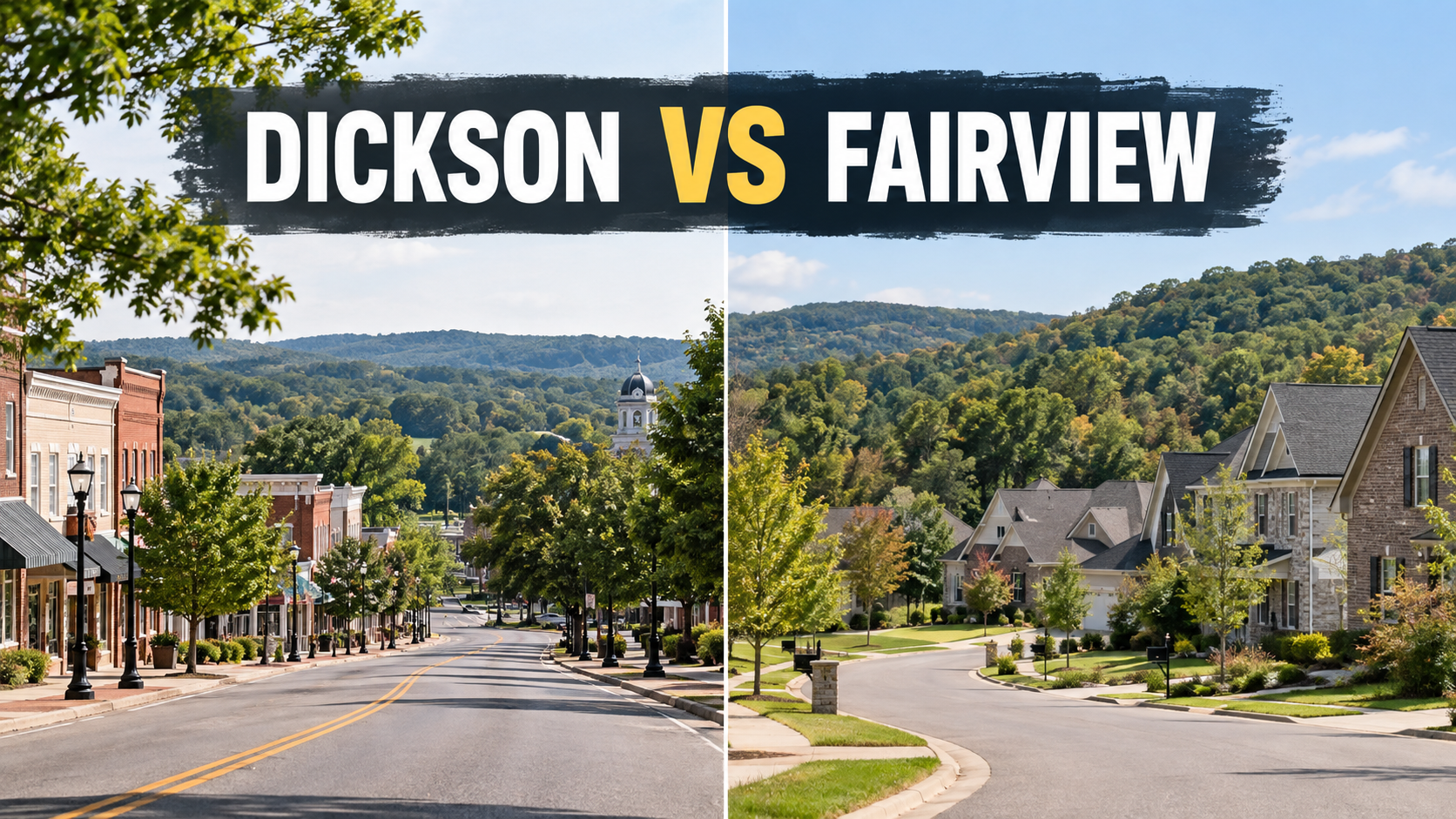
Dickson vs Fairview TN comes down to the trade between Dickson’s broader small-city value and westward space against Fairview’s Williamson County position and closer access to west Nashville. Dickson often gives buyers a lower public market entry point and more small-town independence, while Fairview commonly commands higher prices for its location and Williamson County setting. The right choice depends more on your weekly routes, property priorities, and payment comfort than on a simple winner-and-loser ranking.
Last updated September 15, 2026. Public prices are broad market snapshots, not a substitute for a live MLS search, property-specific analysis, or school and tax verification.
Dickson vs Fairview: quick comparison
| Factor | Dickson | Fairview |
|---|---|---|
| Public 2026 price direction | Typical value around $345,500; Dickson County July median sale about $354,200 | Typical value around the low-to-mid $500,000s; limited public median-sale coverage |
| Nashville access | Farther west on I-40 | Closer to west Nashville via I-40 and Highway 100 |
| Community feel | Independent small city with its own commercial core | Smaller city tied closely to the west Williamson corridor |
| Housing | Older homes, subdivisions, rural edges, and acreage | Subdivisions, larger lots, rural pockets, and higher price pressure |
| Best for | Budget reach, space, and a self-contained town | Williamson County location and a shorter west-side commute |
What your budget may buy
August 2026 public data showed Dickson’s typical home value around $345,500 and a Dickson County July median sale price around $354,200. Fairview’s typical public value was around the low-to-mid $500,000s, and public median-sale coverage was thinner. That gap explains why the same budget can produce very different shortlists.
In Dickson, a buyer may see more older homes, modest subdivisions, and rural-edge properties at lower entry points. In Fairview, the location and Williamson County demand can push buyers toward a smaller home, smaller lot, older condition, or higher payment. Inventory changes, so this is a strategy distinction rather than a promise.
Public data is most useful as a directional signal. It should not be used to price a particular house because condition, acreage, renovations, school zone, utility setup, and micro-location can outweigh the citywide median. I use the live MLS and recent comparable sales once a buyer’s criteria are clear.
Start with a comfortable payment rather than a maximum approval. Include taxes, insurance, utilities, travel, repairs, and any homeowners-association cost. A lower purchase price can lose some of its advantage if it creates a longer daily drive or a property with more maintenance than you want.
Commute and regional access
Fairview is generally closer to west Nashville and can work well for jobs near Bellevue, the I-40 corridor, or parts of Williamson County. Dickson sits farther west, which makes the commute longer but can preserve budget or acreage.
Route details matter. Fairview trips may use Highway 100 or I-40, while Dickson commuters rely heavily on I-40 or state highways. A crash or construction can affect either route, so test the exact address and schedule.
Use the Tuesday test: drive from a realistic home location to your most important destination on a normal midweek morning, then make the return trip at the time you would typically leave. Repeat for school or childcare if those routes matter. One honest test is more valuable than a dozen optimistic map estimates.
Housing character, lots, and utilities
Dickson has a wider sense of separation from Nashville and offers an established small-city core, subdivisions, older homes, and rural surroundings. Fairview combines suburban growth with wooded and rural pockets, but available land and newer homes often carry a Williamson County premium.
Buyers in both markets should confirm sewer or septic, internet, road access, drainage, and restrictions. The city name alone does not tell you which services are available.
For any property outside a dense municipal area, confirm water source, sewer or septic, internet providers, road maintenance, trash service, emergency access, and any restrictions. Acreage is not automatically usable acreage, so review slope, drainage, easements, soil information, and the location of improvements.
Daily life and amenities
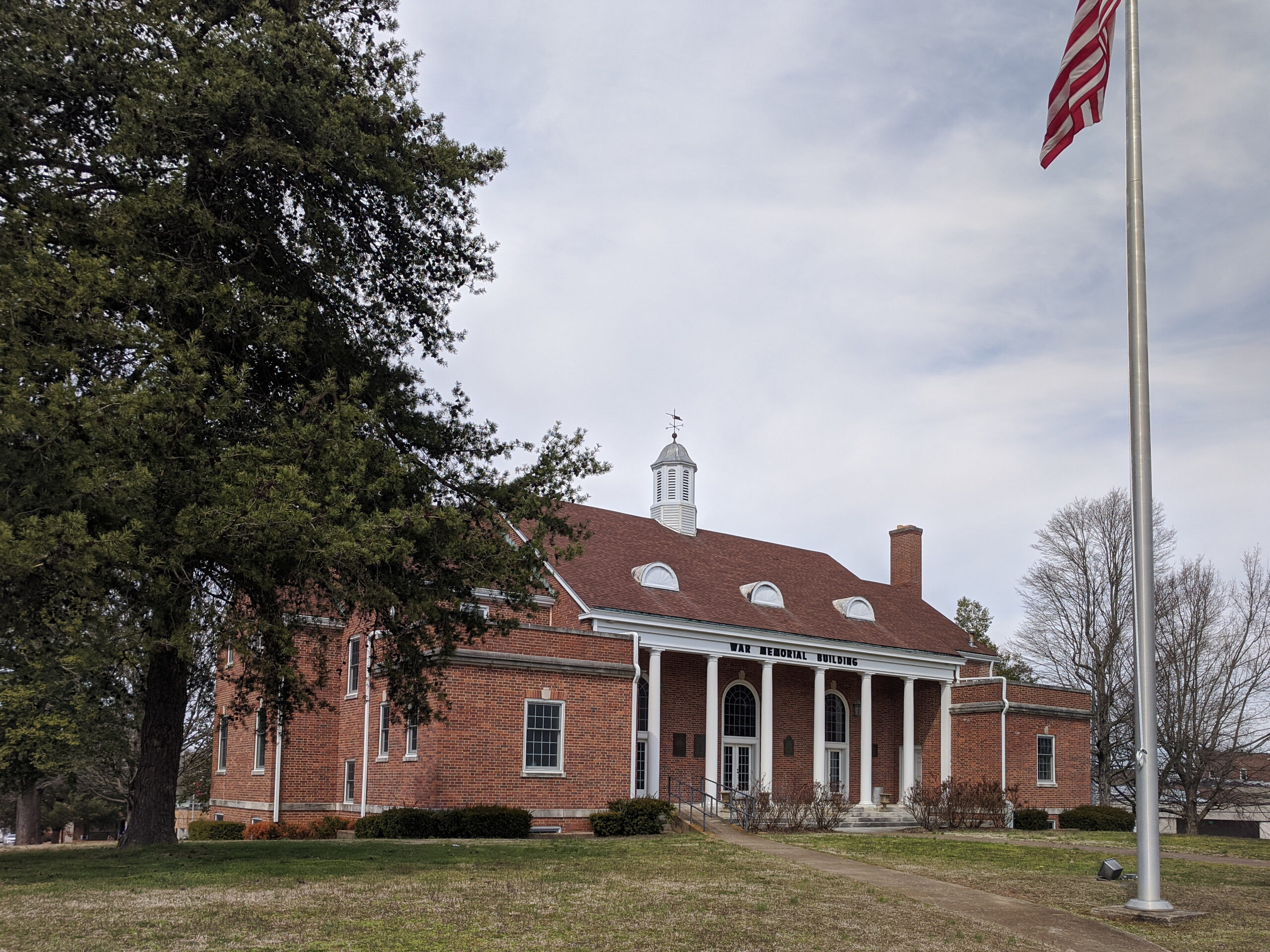
Dickson has a stronger stand-alone commercial center, regional services, and a small-city identity. Residents can handle many errands locally without treating Nashville as the center of every week.
Fairview is smaller and more closely connected to west Nashville and Williamson County. Buyers may value Bowie Nature Park, a quieter setting, and access toward Bellevue, Franklin, or Nashville, while accepting fewer local commercial choices than a larger city.
Think about the errands and activities you do repeatedly. Grocery trips, youth sports, medical appointments, airport runs, restaurants, outdoor recreation, and visiting family all belong in the decision. A quieter setting can be wonderful, but only if the extra driving fits the way you actually live.
Schools and long-term flexibility
School systems and attendance zones are important to many buyers, but they should be researched through official district and state sources. Programs, boundaries, and capacity can change. Even if schools are not part of your immediate plan, understand how the location may affect the future buyer pool.
Fairview’s Williamson County position may support a broad buyer audience, but higher entry cost can reduce flexibility. Dickson’s lower public price point may leave more room for improvements or land, but commute tolerance narrows the buyer pool. Neither outcome is guaranteed.
Market signals to review before choosing
Price is only one market signal. I also review the number of matched listings, recent contract activity, time on market, seller concessions, price reductions, failed contracts, and the gap between list and sale price. Those details show whether a buyer is competing for a rare property or shopping in a segment with room to negotiate.
The same city can contain several markets at once. Entry-level homes may move quickly while higher-priced acreage sits longer. Renovated homes may command a premium because buyers want convenience, while dated homes require a realistic improvement budget. New construction can create competition for resales, but builder incentives may hide differences in closing cost, rate structure, or upgrade pricing.
For a fair comparison, select five to ten recently sold homes in each area that match the target property type. Note square footage, lot size, age, condition, garage, school assignment, utility setup, and seller concessions. Then compare active listings to those closed sales. This prevents one attractive but overpriced listing from becoming the buyer’s mental anchor.
The hidden cost of “more for the money”
More square footage is valuable only when the household will use it. A bonus room, third garage bay, workshop, or extra acre can improve daily life, but each also creates heating, cooling, furnishing, upkeep, and insurance considerations. Buyers should distinguish productive space from space that merely looks impressive during a showing.
Travel time has a similar cost. Estimate weekly commute miles and hours, then add errands, school, recreation, and family trips. Compare that burden with the payment difference. A household may happily accept the drive for a property that supports animals, hobbies, or multigenerational living. Another may find that two saved hours each week are worth more than another bedroom.
Finally, preserve a reserve after closing. Trees, drainage, fencing, driveways, septic systems, roofs, HVAC equipment, and cosmetic updates do not care that the buyer used the full approval amount. A slightly smaller home with a healthy reserve can be the more comfortable purchase.
Build a one-year ownership picture
Before choosing, imagine the first full year in each location. Estimate spring yard work, summer cooling, fall maintenance, winter travel, routine repairs, and the trips that repeat every month. Ask which property features will still matter after the excitement of moving has passed. This exercise is especially useful when one option offers visibly more house but the other offers more time.
Also identify the likely next life change. A new job, growing household, aging parent, home business, or desire to travel can alter how the location performs. You do not need to predict the future perfectly. You only need to avoid a choice that works for one narrow moment and becomes restrictive as soon as circumstances change.
When we tour, I encourage buyers to photograph utility equipment, road approaches, yards, storage, and condition details as carefully as kitchens. Those practical features shape cost and satisfaction long after finishes fade into the background.

Who tends to prefer Dickson?
- Buyers who want a lower entry point or more room for the budget.
- Households comfortable with a longer Nashville commute.
- People who value an independent small-city core and regional services.
- Buyers interested in rural edges or acreage west of Nashville.
Who tends to prefer Fairview?
- Buyers who prioritize access to west Nashville or Williamson County.
- Households comfortable paying more for location.
- People who prefer a smaller city with suburban and wooded surroundings.
- Buyers willing to trade some budget reach for commute and county position.
A practical decision framework
Score each area from one to five on these categories: housing fit, total monthly cost, commute, recurring errands, outdoor space, and long-term flexibility. Give extra weight to the two factors that matter most. Then tour representative homes in both places rather than comparing the best listing in one area with an average listing in the other.
If the results are close, test the compromise. Would you accept a smaller lot to gain time every week? Would you trade newer construction for a more established location? Would a lower payment meaningfully improve your lifestyle, or would the travel burden erase the benefit? Those questions usually reveal the better fit.
Common comparison mistakes
- Comparing list prices without checking recent sale prices, concessions, condition, and time on market.
- Using a single commute estimate instead of driving the route at a realistic time.
- Assuming the city name determines schools, taxes, utilities, or mailing address.
- Ignoring the cost and time required to maintain a larger lot or older property.
- Treating future road projects, retail plans, or appreciation as guaranteed.
- Making the decision before seeing ordinary neighborhoods and representative homes in both areas.
How I would structure the search
First, we define the payment, destinations, property type, and non-negotiables. Second, I build matched searches in both areas so the homes are comparable. Third, we review recent sales and identify the features that create the price gap. Finally, we spend a decision day testing routes, touring homes, and revisiting the strongest option at a different time.
You can also use the Middle Tennessee market guide for current context and the areas directory to explore surrounding alternatives. A good comparison should leave you with two or three realistic search zones, not a list of every possible city.
Frequently asked questions
Is Dickson cheaper than Fairview?
Public 2026 measures generally place Dickson below Fairview, but individual homes overlap. Compare matched properties and recent sales.
Which has the easier Nashville commute?
Fairview generally has the advantage for west Nashville. The exact result depends on the address, job site, and time of day.
Which area has more land?
Both can offer land, but Dickson and surrounding Dickson County often provide more acreage choices at lower entry points.
How should I compare schools?
Confirm district boundaries and programs directly with official sources for each property. Do not rely solely on a listing, a map layer, or a third-party rating.
Can I compare these areas in one day?
Yes. A focused decision day can cover key corridors, representative homes, and a commute test, although a second visit is helpful when the choice remains close.
What is the best first step?
Share your job location, target payment, property wish list, and top weekly destinations. I can use those details to build matched searches for Dickson and Fairview.
About Harley Pope
Harley Pope is a lifelong Middle Tennessee local and a Realtor with Pope Real Estate Group at The Baker Brokerage. He helps buyers compare communities, pressure-test commutes, understand property tradeoffs, and build a practical plan before they move. Harley and Victoria work as a coordinated team, so relocating clients have local guidance from the first video call through closing and settling in.
Plan your Middle Tennessee move
A relocation becomes much easier when the search starts with your real schedule, budget, and definition of a good day. Contact Harley and Victoria to build a focused plan for your move, or begin with the Middle Tennessee relocation guide.