Nashville-Area Communities to Consider When Moving From Raleigh-Durham
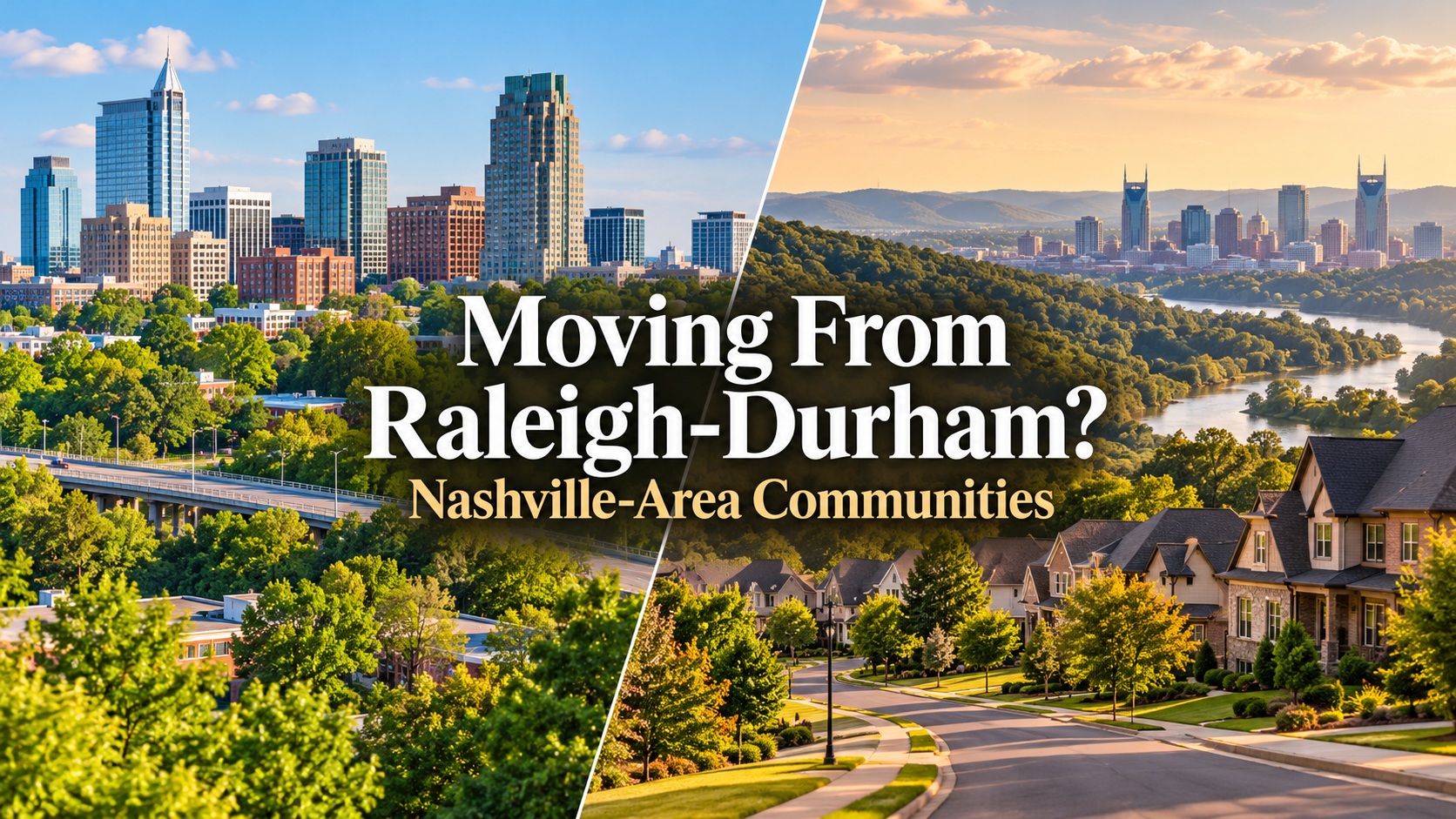
Moving from Raleigh-Durham to the Nashville area can feel familiar and completely different at the same time. Both regions give you a major employment center surrounded by distinct towns and suburbs, but the map, commute patterns, housing choices and pace of growth do not line up community for community.
The best starting point is not asking which Nashville suburb is “the Raleigh” or “the Durham” of Middle Tennessee. A better question is which Nashville-area communities fit the way you want to live after the move. Your answer may depend on access to downtown Nashville, lot size, housing style, airport travel, a walkable center, newer construction or a quieter daily routine.
This guide gives Raleigh-Durham movers a practical shortlist. It is a companion to our Raleigh versus Nashville cost-of-living guide, so we will focus here on community fit rather than repeat the same cost comparison.
Start with your work location and weekly routine
“Nashville area” covers a wide footprint. A community that works well for someone commuting to Cool Springs may be a poor fit for someone working near the Nashville airport or traveling west toward Dickson. Before comparing houses, mark the places you expect to visit every week: office, airport, family, medical providers, hobbies and regular social plans.
Then test routes at the times you would actually travel. Do not rely on a single mileage number or an ideal drive time. Construction, school traffic, event traffic and the direction of your commute all matter. If you work remotely, decide how much you value proximity to Nashville against space, price range and a smaller-town setting.
Tennessee does not tax earned personal income at the state level, but that single fact is not a complete cost picture. Property taxes, insurance, utilities, transportation and local tax rates vary. Use current county and municipal sources, then review the specific property with your lender and insurance professional.
Nashville: for buyers who want the city itself
Nashville belongs on the list when city access is the priority. It offers the widest range of neighborhoods in this guide, from urban condos and historic homes to established residential areas and newer infill. The city can work well for movers who want shorter access to downtown employers, major venues, hospitals, the airport and a large restaurant and entertainment scene.
The tradeoff is that “Nashville” is too broad to treat as one housing market. Parking, lot size, home age, street feel and daily routes can change significantly within a few miles. Buyers should compare individual neighborhoods and inspect renovated or older homes carefully rather than assuming the same condition and maintenance profile across the city.
Brentwood: established suburban access south of Nashville
Brentwood may appeal to movers who want an established suburban setting between Nashville and Franklin. It is convenient to major employment areas in the southern part of the region and has many larger homes and mature neighborhoods.
Inventory can be limited by location, price range and lot expectations. The Brentwood mailing address also does not always tell the full story about county, municipal boundaries or services. Verify the exact parcel, tax jurisdiction and utility details before treating two listings as direct substitutes.
Franklin: a strong center of its own
Franklin is one of the first names many relocation buyers encounter. Its historic downtown, business centers, shopping and established neighborhoods make it more than a bedroom community. It can fit households that want access to Cool Springs and Williamson County while keeping a defined town center nearby.
Popularity affects both price and competition, so clarify which part of the Franklin experience matters most. A home near downtown, a newer subdivision farther from the center and a rural-edge property can produce very different routines. Tour the routes, not just the houses, and compare what each location gives up in exchange for space or convenience.

Thompson’s Station: smaller-town setting in Williamson County
Thompson’s Station sits south of Franklin and offers a smaller-town identity with access to the broader Williamson County corridor. It often enters the conversation for buyers looking at newer communities, more residential surroundings or a position between Franklin and Spring Hill.
Rapid growth means roads, new construction and future development deserve close attention. Ask what is already approved near a property and drive the commute during a normal weekday. A quiet weekend tour can hide the practical difference between two routes.
Spring Hill: growth across two counties
Spring Hill is a common relocation choice because it combines newer housing, retail growth and access to the southern Nashville corridor. It spans Williamson and Maury counties, which makes the exact address important for taxes, services and other property-specific details.
For Raleigh-Durham movers accustomed to a fast-growing suburban edge, Spring Hill may feel familiar in its pace of development. That growth also creates practical questions about traffic and construction. Compare eastern and western routes, confirm county boundaries and review planned development around any home you are considering.
Columbia: a regional center with more distance from Nashville
Columbia gives buyers a historic downtown, established neighborhoods, newer construction and access to Maury County employment and services. It can make sense for remote workers, people employed south of Nashville or buyers who value a regional center without needing to be close to downtown Nashville every day.
The key tradeoff is distance. Columbia is not a close Nashville suburb in the way Brentwood is. If your routine requires frequent trips to Nashville, test the drive honestly. If your life is centered in Maury County or you travel less often, the broader housing range and local identity may be more important.
Dickson: west of Nashville with its own daily conveniences
Dickson deserves consideration from buyers who want to look west instead of following the better-known southern growth corridor. It has a traditional downtown, shopping, medical services and access to Interstate 40 while retaining a smaller-city scale.
Dickson works best when the west-side location supports your actual routine. A downtown Nashville commute is different from remote work, travel toward Clarksville or work based in Dickson County. Housing can include established neighborhoods, newer subdivisions and properties with more land, but utilities and internet should be verified address by address outside denser areas.
White Bluff and Burns: smaller Dickson County options
White Bluff and Burns can be useful additions to a west-side search. White Bluff offers a small-town center and a position between Dickson and Nashville. Burns is close to Dickson and Montgomery Bell State Park, with a more residential and rural mix depending on the address.
These communities are not interchangeable with Dickson proper. Confirm commute routes, utility providers, internet service, emergency-service jurisdiction and the distance to the stores or services you use most. Buyers seeking acreage should also review surveys, septic information, road access and restrictions early.
Gallatin: a northeast option with a historic center
Gallatin expands the search northeast of Nashville. It has a historic square, established neighborhoods, newer development and proximity to Old Hickory Lake. It may suit movers whose employment, family or recreation pulls them toward Sumner County.
Gallatin is not a practical substitute for every south- or west-side community. Cross-region trips can add time and complexity. Put it on the list when the northeast side matches your routine, not simply because a house looks attractive online.
How Raleigh-Durham movers can build a useful shortlist
Begin with three communities, not ten. Choose one that maximizes convenience, one that offers the housing type or space you want and one that tests a different part of the region. A useful first tour might compare Nashville, Franklin and Spring Hill for a south-side commuter. A remote worker might compare Columbia, Dickson and White Bluff. Someone working in Cool Springs might focus on Brentwood, Franklin and Thompson’s Station.
On each tour, note ordinary details: where you would buy groceries, how you enter the neighborhood, road noise, slope and drainage, the condition of nearby homes, cellular signal and the route to your weekly destinations. Return at a second time of day before making a major decision.
For new construction, compare the builder contract, incentives, lot premiums, expected completion date and what is actually included. For resale homes, consider age, renovation quality and near-term maintenance. In rural or edge locations, verify utilities, septic records, surveys, access and internet before the inspection period becomes compressed.
Compare the house and the jurisdiction together
Relocation searches often begin with a city name, but the property’s jurisdiction can matter as much as the mailing address. Spring Hill crosses county lines. Brentwood addresses can require a closer look at municipal and county details. Rural-edge properties may rely on different utility providers or private systems. Ask for the parcel record and verify the facts that apply to that address.
This is also why online tax estimates should be treated as a starting point. A portal may use a prior assessment, omit a municipal component or calculate a future payment differently from your lender. Review current official records and ask how a sale, new construction or a change in exemptions could affect the estimate.
Plan a relocation visit that answers real questions
A useful first visit should include ordinary life, not only showings. Drive from a possible neighborhood to the employment area. Stop at a grocery store. Notice the road at the morning and evening peak. If you expect to fly regularly, test the airport route. If outdoor recreation matters, compare the actual trail, lake or park access you would use.
Keep notes on the same categories for every community: housing type, lot, age, drive, daily services, construction nearby and any property-specific follow-up. That creates a fair comparison when the homes themselves are different. Photos and listing remarks are helpful, but they cannot show noise, topography, traffic flow or how a route feels at the hour you would travel.
Buying before you arrive
Some Raleigh-Durham movers need to secure a Middle Tennessee home before they can make several trips. In that situation, agree on a clear virtual-tour process. Ask the person filming to show the street, neighboring homes, driveway grade, utility equipment, ceilings, mechanical systems and views from each window. A smooth highlight video is not a substitute for a methodical walkthrough.
Contract timing also deserves attention when a North Carolina sale and Tennessee purchase depend on each other. Coordinate with your lender and closing professionals early. Build realistic time for inspections, travel, movers and any temporary housing. The right community choice still needs a workable transaction plan.
Relocation help should connect the map to the property
An online community list is only the first filter. The next step is connecting your work location, budget, preferred housing style and tolerance for driving to actual inventory. Our Middle Tennessee relocation service helps buyers narrow the region before spending a trip driving between communities that do not fit.
Harley and Victoria Pope can also coordinate virtual tours, property-specific questions and an efficient in-person route. The goal is to give you enough context to decide where to look, then verify the details that matter on the exact home.
Frequently asked questions
Is Nashville more expensive than Raleigh-Durham?
Costs depend on the exact communities, home type, commute and property. Use our linked cost-of-living guide as a starting point, then compare current listings, taxes, insurance and transportation for the properties on your shortlist.
Which Nashville-area community feels most like Raleigh or Durham?
There is no reliable one-to-one match. Nashville offers the largest urban range, Franklin has a strong center of its own, and fast-growing communities such as Spring Hill may feel familiar to suburban Triangle movers. Choose by routine and property fit rather than a label.
Where should remote workers look?
Remote work can widen the search to Columbia, Dickson, White Bluff, Burns and other communities farther from Nashville. Verify internet service at the exact address and decide how often you still need the airport, meetings or city amenities.
How many communities should I tour on a first visit?
Three focused communities usually produce better comparisons than a rushed tour of the entire region. Select communities that test different tradeoffs, then add or remove areas based on what you learn.
What should I verify before making an offer?
Confirm jurisdiction, taxes, utilities, internet, commute routes and property-specific records. Depending on the home, that may include surveys, septic information, restrictions, permits and new-construction documents.
About Harley Pope
Harley Pope and Victoria Pope lead Pope Group at The Baker Brokerage, a husband and wife real estate team serving relocating buyers across Middle Tennessee. They help clients compare communities, understand property-specific details and plan an efficient move from first conversation through closing.