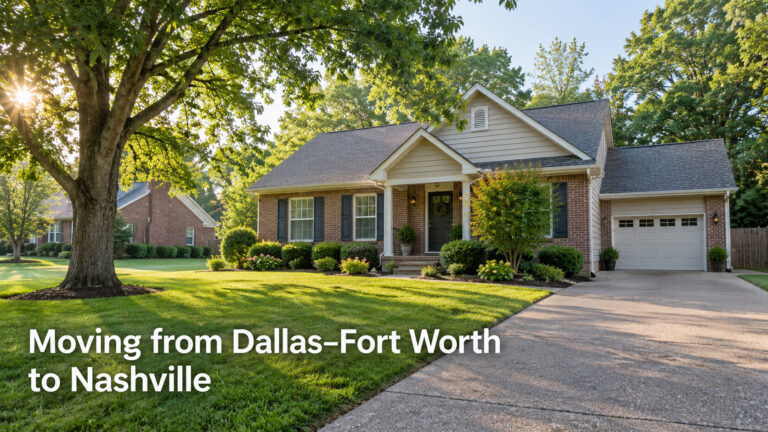
What a Detroit Home Budget Buys in Nashville and Middle Tennessee

What a Detroit home budget buys in Nashville and Middle Tennessee cannot be answered by comparing two citywide medians. Your current property, sale proceeds, replacement mortgage and chosen Tennessee location determine the real trade. Set a comfortable payment and reserve first, then compare actual homes for condition, layout, travel and ownership costs rather than assuming the same price buys the same experience.
Last updated: October 5, 2026. Dollar examples are hypothetical search brackets, not claims about current listings or a guaranteed market difference.
I’m Harley Pope, a lifelong Middle Tennessee local and a Realtor with Pope Real Estate Group at The Baker Brokerage. Victoria and I help relocating clients compare properties and coordinate the move with their current agent.
Detroit is a starting address, not a single home value
The Detroit region contains very different houses and price points. A restored older house in a particular neighborhood, a condominium, a suburban home with a basement and a newer property have different sale prospects. Ask your Michigan agent for a price range grounded in your property, condition and recent comparable sales. Then calculate proceeds after payoff, sale expenses and a conservative allowance for preparation or negotiation.
Separate equity from available cash. You may decide to use only part of the proceeds for a down payment and keep the rest for the move and first-year work. If you still owe on the Michigan home, a lender needs the actual payoff and any timing dependency. If you plan to retain it, ask how the existing payment and potential rental income are treated in your qualification; do not assume future rent erases the obligation.
The Detroit-to-Nashville relocation guide can help organize the wider transition. Use it with a property-specific budget rather than replacing the calculation with a general comparison between states.
Identify the functions your current house provides
Write down what makes the current house work in ordinary weeks. Does a basement hold seasonal gear or serve as finished living space? Is there a covered parking arrangement, workshop, walkable errand route, detached garage or established yard? Which of those functions do you actually want to preserve? A Tennessee house can have more above-grade space and still feel less useful if storage or room separation is missing.
Older Detroit-area homes may have architectural details that are hard to match with a generic new subdivision house. A buyer who values those details should look at established Tennessee properties as well as newer options. Conversely, someone tired of maintaining an older house may prefer simpler systems or a smaller lot even if the new address offers less character. Neither choice is universally better.
Describe your essential layout in plain terms: a workspace away from living noise, main-level sleeping option, access without many steps, parking for the vehicles you own, outdoor area you will use. Then identify one or two desirable extras. This gives the search a practical order when a promising listing trades one feature for another.

Use illustrative brackets as a worksheet
Imagine exploring $350,000, $550,000 and $800,000 purchase ceilings. These are arbitrary planning points, not estimates of what a specific Tennessee city currently offers. At 20 percent down, the simple down-payment arithmetic is $70,000, $110,000 and $160,000, before closing costs and reserves. Your actual loan may use a different down payment or mortgage insurance structure. Ask your lender to calculate the monthly and cash-to-close figures.
At each bracket, pull current listings on the same date that meet your essential layout. Include the actual address, condition, dues, likely work, taxes and insurance quote. A central Nashville townhome, an established detached house and a farther-out property can have very different ownership obligations at one asking price. Record the first-year and ongoing costs separately.
The CFPB’s Loan Estimate comparison explains how to compare lender offers. If you currently hold a favorable loan rate, your replacement payment can increase even without a large price jump. Do not infer buying power from gross sale price or a preapproval maximum alone.
Begin with Nashville if your destinations point there
The Nashville area guide is a useful geographic starting point. Map the actual workplace, recurring appointments, airport trips and activities that matter to you. A route across town can be more consequential than the distance to downtown. Test candidate routes at the time you would drive them, especially if two household members travel in different directions.
Within Nashville, compare property types honestly. A smaller home closer to regular destinations may save time but offer less land. A townhome may trade yard work for dues and restrictions. An older detached home may offer a setting you like while requiring more near-term maintenance. New construction can change the mix again. Choose the location for a daily reason, then test the house and its full cost.
Do not use a single citywide market statistic to claim a home is within budget. Inventory changes, and a specific property may have an HOA, condition issue or competitive offer situation. The Middle Tennessee relocation resource can help structure questions, but a current address-level comparison is the decision tool.
Test the southern route against the home you gain
If your recurring destinations point south, compare Brentwood, Franklin, Spring Hill and Columbia selectively. Each has varied homes and distinct routes. The farther address should solve a housing or lifestyle need valuable enough to justify its travel and ownership costs. It is not automatically a bargain because it sits outside Nashville.
Tour a few homes that meet the same essential criteria in two areas, then compare what changes: usable rooms, lot, immediate work, taxes, dues and route. A newer large house can still be a poor fit if its room arrangement or commute undermines an ordinary week. An older smaller property might work better if it places the right functions where you need them.
When a particular school, utility or jurisdiction matters, verify the exact property with the responsible entity. Search portals and city labels are insufficient for an important condition of purchase. Keep your comparison objective and property-based rather than asking an agent to identify an area by the demographic makeup of its residents.
Investigate west and northwest without a blanket value claim
The Dickson County guide can orient a west-side search. Ashland City and other northwest choices may be relevant for a different route. Start with where you need to travel. A home with an appealing lot can add lawn care, tree work, drainage considerations, equipment and time in a vehicle. Those costs belong beside the asking price.
If you want acreage, inspect whether it is usable for the purpose you have in mind. A wooded buffer, garden, shop or animal-related use may involve different restrictions, terrain, water, wastewater and access. Verify proposed uses with the appropriate authorities and documents before treating a listing’s land as ready for your plan. A beautiful view alone does not answer those questions.
Some buyers moving from the Detroit area prefer a more rural Tennessee setting; others realize they use nearby services more than they expected. A focused scouting trip can reveal that preference more reliably than an online ranking of counties.
Recalculate taxes, insurance and maintenance
Tennessee property taxes are administered locally. The state’s property-tax overview explains the roles of assessors and local governments. Obtain an address-specific estimate that accounts for the relevant county and city, and confirm how a transfer or reassessment might affect your assumption. Do not multiply a current owner’s bill by a general ratio and treat it as a final quote.
Ask an insurance professional to quote the specific home. Add HOA dues where applicable, utilities, landscaping and a maintenance reserve. For an older home, obtain inspection information and qualified estimates before deciding that a low purchase price is a low total cost. For a newer house, read the warranty and exclusions and consider site drainage, finishing work and association obligations.
Do not reduce the move to an income-tax slogan. Your household’s state and federal tax situation, housing payment, insurance and daily spending require individualized advice. The Detroit versus Nashville cost guide offers broader comparison questions, but it cannot calculate your actual post-move budget.
Compare Tennessee construction with the Detroit home you know
The systems and features you encounter may differ from your current property. Ask about crawlspaces, basements, drainage, HVAC, roofs, foundations, private wastewater or wells where present. Do not assume every home in an area uses the same system. Review disclosures and permits and hire appropriate inspectors. A newly renovated interior can conceal expensive work as easily as an older facade can distract from a sound structure.
For new construction, request the actual available home’s delivered price, included finishes, lot premium, completion date, warranty and incentive terms. A promotional payment may depend on financing through a designated lender or a temporary buydown. Compare written Loan Estimates and the payment after the initial period. For resale, look at included appliances, established outdoor work and condition with the same rigor.
The best choice may be a home that deliberately changes your living pattern rather than reproducing the Michigan house. Make that decision consciously. If you give up basement storage, know where belongings will go. If you gain land, know who will maintain it. If you choose attached housing, understand the insurance and association structure.
Use a decision trip to test the ordinary day
Before visiting, send your agent the comfortable payment, likely Michigan proceeds, timing and specific functions the house must perform. Limit the first tour to contrasting choices with a reason to be on the list. Drive regular routes, look at grocery and service access, and return to your strongest area after the initial excitement fades.

The Tuesday Test asks whether the home supports parking, work, meals, laundry, storage and appointments on an unremarkable weekday. Walk the lot and look at sunlight, slope, noise and maintenance obligations. A travel video or virtual tour is useful for narrowing, but not a substitute for inspection or document review.
Keep a short property worksheet and write down the unanswered questions while they are fresh. A buyer can fall for an impressive kitchen and forget that the garage will not hold both vehicles. Practical comparison protects you from choosing the best photograph rather than the best home for your life.
Coordinate the Michigan sale and Tennessee purchase
Map the calendar with your Michigan agent, Tennessee agent, lender and closing teams. Decide whether you must sell first, can carry overlap or would benefit from temporary housing. Ask how a sale contingency, appraisal, financing and possession would work in a specific offer. Do not assume a same-day closing will be seamless merely because both contracts list the same date.
Update the Tennessee plan if the Michigan price, concessions or closing date changes. Preserve a realistic reserve for moving and repairs. At the offer stage, compare total terms, not simply the winning price. Inspection rights and deadlines, appraisal language, closing costs and access to proceeds can determine whether the purchase is viable.
If a Detroit-area Realtor is helping with the handoff, our referral partner page provides a direct way to coordinate the Tennessee search while preserving the original relationship. Clear communication across both transactions is part of the financial plan.
Frequently Asked Questions
Does a Detroit sale price translate directly into a Nashville purchase price?
No. Subtract payoff and selling expenses, preserve move and repair reserves, and have a lender quote the replacement payment. The type and location of both homes matter more than a citywide ratio.
Will I find a basement in Middle Tennessee?
Some homes have basements, but do not assume one is available within every location and budget. Decide what the basement does for you, then compare homes with that feature or another workable storage and living arrangement.
Should I search farther out for more land?
Only if the land’s use and maintenance fit your goals and the route works. Verify access, utilities, restrictions and terrain for the specific property before paying for acreage.
Are new homes cheaper to own than older resales?
Not automatically. Compare delivered price, dues, insurance, warranty limits and finishing costs with the resale’s inspected systems and immediate work. Both need a first-year reserve.
What if the Michigan closing is delayed?
Tell the lender and both agents immediately. Contract deadlines, available funds and any contingency determine the options. An earlier discussion of overlap or temporary housing makes a delay easier to manage.
About Harley Pope
Harley Pope is a lifelong Middle Tennessee local and a Realtor with Pope Real Estate Group at The Baker Brokerage. He helps relocating buyers compare Nashville, Dickson County, Maury County and surrounding markets through actual homes, routes and ownership obligations. He works with the buyer’s lender and current-market agent to keep the Tennessee search aligned with proceeds, timing and contract terms.
If you are moving from the Detroit area, Harley and Victoria Pope can help turn your expected proceeds and daily priorities into a focused Middle Tennessee search. Contact Pope Real Estate Group with your timeline and the functions you want your next home to provide.