
Las Vegas vs Nashville Cost of Living
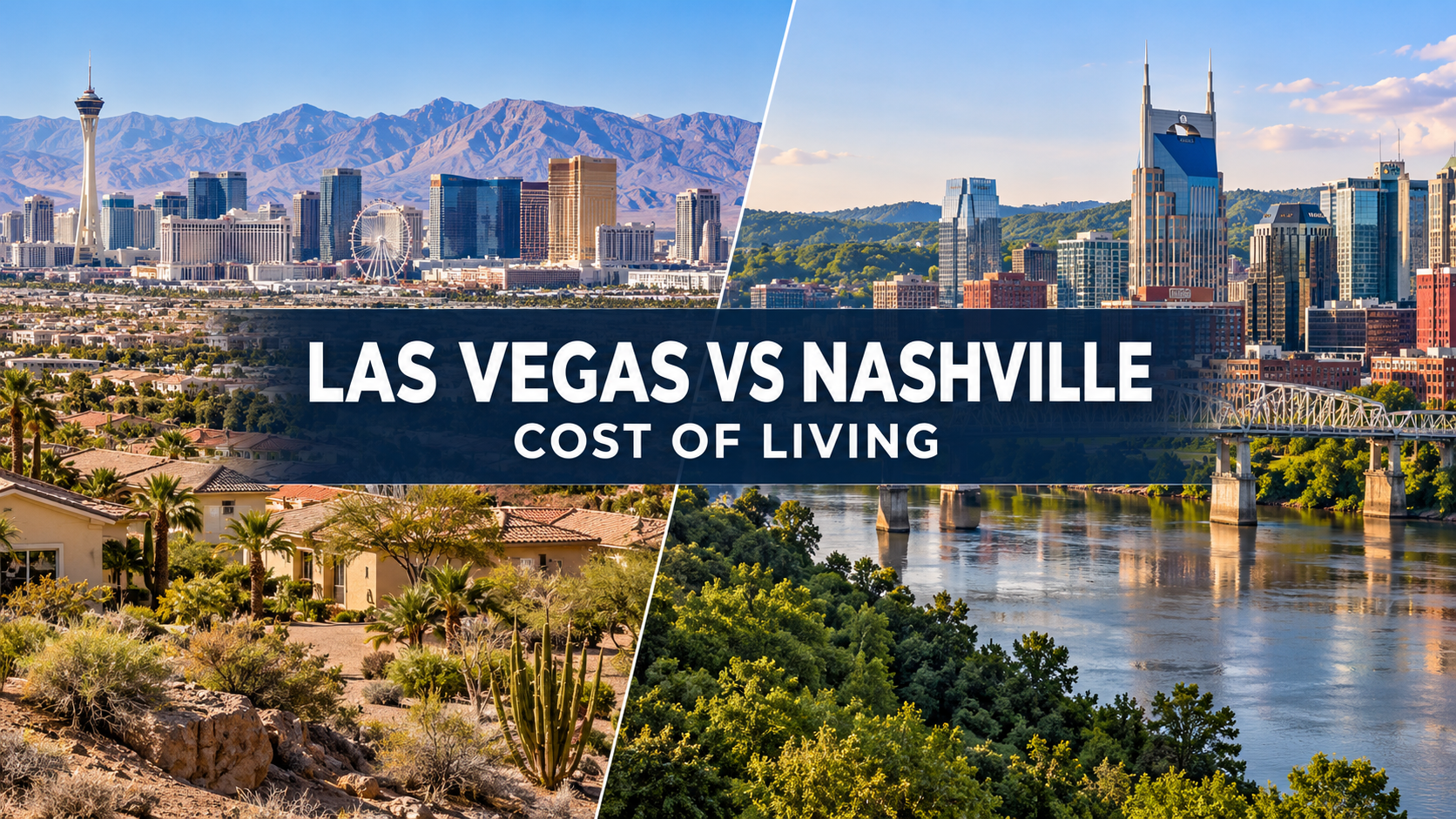
Las Vegas vs Nashville cost of living depends less on one national index than on the home, tax situation, insurance exposure, transportation pattern, and daily routine you are comparing. Nevada and Tennessee both avoid a state tax on individual wages, so housing, cooling, water, insurance, association costs, and commuting do most of the financial work. The right question is not merely which metro is cheaper. It is what the same income and total monthly budget would allow your household to do in each place.
Last updated: September 22, 2026
This planning guide uses current public benchmarks from the U.S. Census Bureau, Bureau of Economic Analysis, state tax agencies, and property-specific due diligence principles. Public data can describe a metro, but it cannot quote the cost of a house you have not selected. I’m Harley Pope with Pope Real Estate Group at The Baker Brokerage, and I help relocating buyers compare Nashville with the surrounding Middle Tennessee communities where budget, commute, property type, and ordinary life may fit differently.
Las Vegas vs Nashville cost of living: the short answer
The tax headline is nearly a draw for many wage earners. Las Vegas and Nashville differ more in climate, water, insurance risk, housing design, vegetation, and regional geography. Las Vegas offers a compact valley and extensive planned development; Nashville offers greener terrain, a broader small-town and acreage market, and more weather-driven property maintenance.
| Budget question | Las Vegas | Nashville and Middle Tennessee |
|---|---|---|
| Housing pattern | Desert subdivisions, condos, planned communities, and HOA-managed neighborhoods | Urban neighborhoods, suburban communities, small towns, and rural acreage |
| State tax on wages | Nevada does not impose a tax on individual wages | Tennessee does not tax earned personal income |
| Transportation | Car-oriented valley with concentrated resort and regional job corridors | Car-oriented, with location and corridor choice shaping the week |
| Ownership risk | Extreme heat, water use, cooling systems, desert soils, roofs, and flash flooding | Storms, hail, drainage, trees, roof condition, and rural systems |
| Easy-to-miss cost | Assuming two no-income-tax states produce the same household budget | Buying farther out without pricing the recurring drive |
Treat the table as a checklist, not a verdict. A useful comparison starts with two or three real properties in each region, the actual tax record, current insurance quotes, expected utilities, association charges, maintenance, and the routes you will drive. A single percentage cannot account for those choices.
Housing: compare the same kind of life, not just two median prices
Las Vegas housing includes master-planned communities, stucco subdivisions, condos, townhomes, age-restricted communities, and custom desert properties. HOA rules, solar arrangements, pool equipment, roof and HVAC age, water use, and location within the valley can change the monthly plan.
Nashville housing includes urban homes and condos, large suburban communities, older small-town houses, and rural acreage. A buyer leaving the desert should prepare for more vegetation, rain, drainage, pests, tree work, crawl spaces, and private systems. More green space is not free space to maintain.
A median sale price can help describe a market, but it is a poor stand-in for your search. It mixes different home sizes, ages, locations, lot types, and conditions. It may also move sharply when a small number of expensive or inexpensive sales closes in a month. The practical method is to define a property brief first: payment ceiling, bedrooms, usable square footage, lot preference, parking, condition, and maximum drive. Then compare what is actually available in the parts of each metro that support your routine.
On the Tennessee side, do not limit the exercise to Davidson County. Buyers may consider Nashville, Williamson County, Maury County, Cheatham County, Dickson County, Rutherford County, Sumner County, or Wilson County. Each changes price, taxes, home age, lot size, utilities, and commute. The Middle Tennessee areas directory is a better starting point than assuming every Nashville-area buyer should live near downtown.

Taxes: calculate the household result, not a slogan
Nevada and Tennessee do not currently impose a broad individual income tax on wages. That removes the most obvious difference in many relocation comparisons. Business taxes, investment income, retirement issues, residency, and employer arrangements still deserve professional review.
The practical tax comparison moves to sales taxes, property taxes, vehicle costs, and local fees. Add insurance, HOA dues, utilities, water, pool costs, landscaping, and transportation. A household can spend more in the supposedly cheaper city because of the property selected.
Ask a qualified tax professional to compare wages, self-employment income, investment income, retirement income, deductions, residency timing, and business obligations. Then add property taxes, sales taxes, vehicle costs, and local fees. A move can lower one tax line while increasing another. The useful figure is annual after-tax cash flow under your facts, not the highest published rate or a social-media graphic.
The monthly ownership payment is larger than principal and interest
Las Vegas due diligence may include HVAC capacity and age, roof type, pool condition, solar lease or ownership terms, water fixtures, desert grading, flash-flood exposure, HOA restrictions, and the impact of extreme heat on finishes and equipment.
Nashville due diligence includes roof and storm history, HVAC and humidity control, drainage, trees, crawl spaces, pests, flood maps, septic or well systems, and the cost of maintaining lawns and wooded lots. Severe rain and wind replace the desert’s heat and water focus.
For any candidate house, total principal, interest, property tax, homeowners insurance, mortgage insurance when applicable, association dues, utilities, and a maintenance reserve. Add property-specific items such as a pool, older mechanical systems, private road, detached building, acreage, septic system, retaining wall, or mature trees. Obtain the insurance quote during the contingency period. Two homes with the same price can produce very different monthly obligations.
Transportation can erase a housing bargain
Las Vegas is car-oriented, but the valley’s geography can make the region feel more bounded. Resort-corridor traffic, event schedules, airport access, and employment hours may shape the commute. Summer heat also affects walking and vehicle wear.
Nashville spreads along interstates, radial roads, and surrounding counties. A lower-priced outer home can add significant mileage. A Las Vegas buyer should not assume a similar map distance produces a similar drive across hills, rivers, and limited corridors.
Build the search map around recurring destinations. Include work, medical appointments, airport trips, family, childcare, groceries, worship, and recreation. Test routes during the times you expect to travel. The Nashville neighborhood search guide explains how to organize a search around budget, commute, and home style instead of beginning with a list of fashionable place names.
Climate, utilities, and maintenance
Las Vegas extreme heat drives air-conditioning capacity, shade, vehicle care, pool evaporation, water use, desert landscaping, and outdoor timing. Rain is limited, but flash flooding and intense sun still create property risks.
Nashville trades dry heat for humidity, heavy rain, thunderstorms, tornadoes, hail, pollen, trees, and occasional ice. Cooling remains important, and vegetation or moisture can produce a larger maintenance load than a newcomer expects.
In Middle Tennessee, buyers should review roof age, storm history, drainage, grading, trees, crawl-space or basement moisture, HVAC condition, and mapped flood risk. Rural properties may add wells, septic systems, propane, private roads, and internet verification. Ask for available utility history and price the normal replacements a house will require. Climate is not only a preference. It changes insurance, maintenance, energy use, landscaping, and how frequently outdoor space is usable.

What changes in everyday life
Las Vegas is shaped by tourism, hospitality, conventions, entertainment, construction, logistics, and a 24-hour service economy. The desert landscape and access to the Southwest are part of the appeal. Work schedules may not follow a traditional week.
Nashville also has tourism and entertainment, but its economy and geography include healthcare, education, logistics, manufacturing, suburban employment, and surrounding rural communities. The city is greener and the seasonal rhythm is more pronounced.
This is where I use The Tuesday Test. Picture an ordinary Tuesday six months after the move. How long do the repeat trips take? Is the house easy to maintain? Can you use the office, garage, yard, sidewalks, or nearby services the way you expected? A move that looks efficient on a spreadsheet can still be wrong if the location complicates every week. Great homes make ordinary days better, and the budget should support that life after closing.
How to compare Nashville-area options
Use one closer-in option, one middle-distance option, and one farther-out space or value option. That keeps the tradeoff visible. For example, compare an urban or inner-suburban home with a property in Franklin, Spring Hill, Columbia, or Dickson only when those locations fit the destinations you will actually use. Do not let a lower asking price hide an exhausting drive or a property type you do not want.
A Las Vegas buyer who likes planned communities may compare southern, eastern, and northern Nashville suburbs. Someone moving for acreage or a more rural setting may look toward Maury, Dickson, Cheatham, or Hickman County. The latter choice should include maintenance, internet, septic, and commute checks.
If you are buying before you know the region well, use the out-of-state Tennessee home-buying guide to organize financing, showings, inspections, and travel. The broader Middle Tennessee relocation guide helps you narrow the map before a decision trip.
A practical Las Vegas-to-Nashville comparison plan
- Write the complete monthly ceiling. Include taxes, insurance, dues, utilities, maintenance, and transportation, not only the lender payment.
- Define the ordinary week. List every destination that repeats and how often it matters.
- Compare equivalent properties. Use the same bedroom count, condition, lot expectations, and drive-time tolerance.
- Request property-specific quotes. Insurance, taxes, utilities, and association obligations should be attached to real addresses.
- Plan a decision trip. Drive routes at realistic hours and tour contrasting home types instead of only polished favorites.
- Coordinate the old and new home. Decide whether you must sell first, can carry overlap, or need temporary housing.
- Re-run the Tuesday Test. Choose the option that works after the excitement of moving wears off.
For city-specific logistics, read the Las Vegas-to-Nashville relocation guide. If a Realtor in Las Vegas is coordinating the move, the Las Vegas Realtor referral guide explains how I protect the existing agent relationship while handling the Tennessee side.
Who may prefer Las Vegas, and who may prefer Nashville?
Las Vegas may fit someone who values a dry climate, desert and Southwest access, planned-community options, Nevada ties, and the region’s hospitality and entertainment economy.
Nashville may fit someone seeking greenery, four seasons, different employment connections, or access to small towns and land while retaining a no-wage-tax state.
The move may disappoint if the household dislikes humidity, tree and lawn maintenance, or longer regional drives. It can work well when Tennessee better supports the desired property and relationships without relying on a tax change that does not exist.
Frequently asked questions
Which city has lower state income tax?
Nevada and Tennessee do not currently impose a broad state individual income tax on wages. Other taxes and household costs still differ.
Is Nashville cooler than Las Vegas?
Nashville has lower peak dry heat but much greater humidity, rain, and storm exposure. Air conditioning remains important in both places.
Will homeowners insurance be cheaper?
Possibly, but not automatically. Las Vegas and Nashville carry different weather and rebuilding risks. Obtain quotes for real addresses.
What home features change most?
Las Vegas buyers often evaluate pools, solar, desert landscaping, cooling, and HOA rules. Nashville adds drainage, trees, crawl spaces, roofs, humidity, and rural systems.
Does Nashville offer more acreage?
The broader Middle Tennessee region does, but acreage can mean a longer commute, more maintenance, septic or well systems, and limited internet choices.
Can my Las Vegas agent refer me?
Yes. Harley Pope can coordinate the Tennessee side and keep the referring Realtor informed.
About Harley Pope
Harley Pope is a Middle Tennessee Realtor with Pope Real Estate Group at The Baker Brokerage. As a lifelong Middle Tennessee local, he helps buyers and relocating households compare Nashville with surrounding communities through practical conversations about housing, land, commute, condition, and everyday life. His goal is a sound decision, not selling a location by ignoring its tradeoffs.
If you are comparing Las Vegas with Nashville, Harley and Victoria Pope can help turn the broad cost question into a property-specific plan. Contact Pope Real Estate Group at The Baker Brokerage to compare search areas, prepare a decision trip, or coordinate with your current Realtor. Call or text Harley at 931-629-4836 or use the contact page.