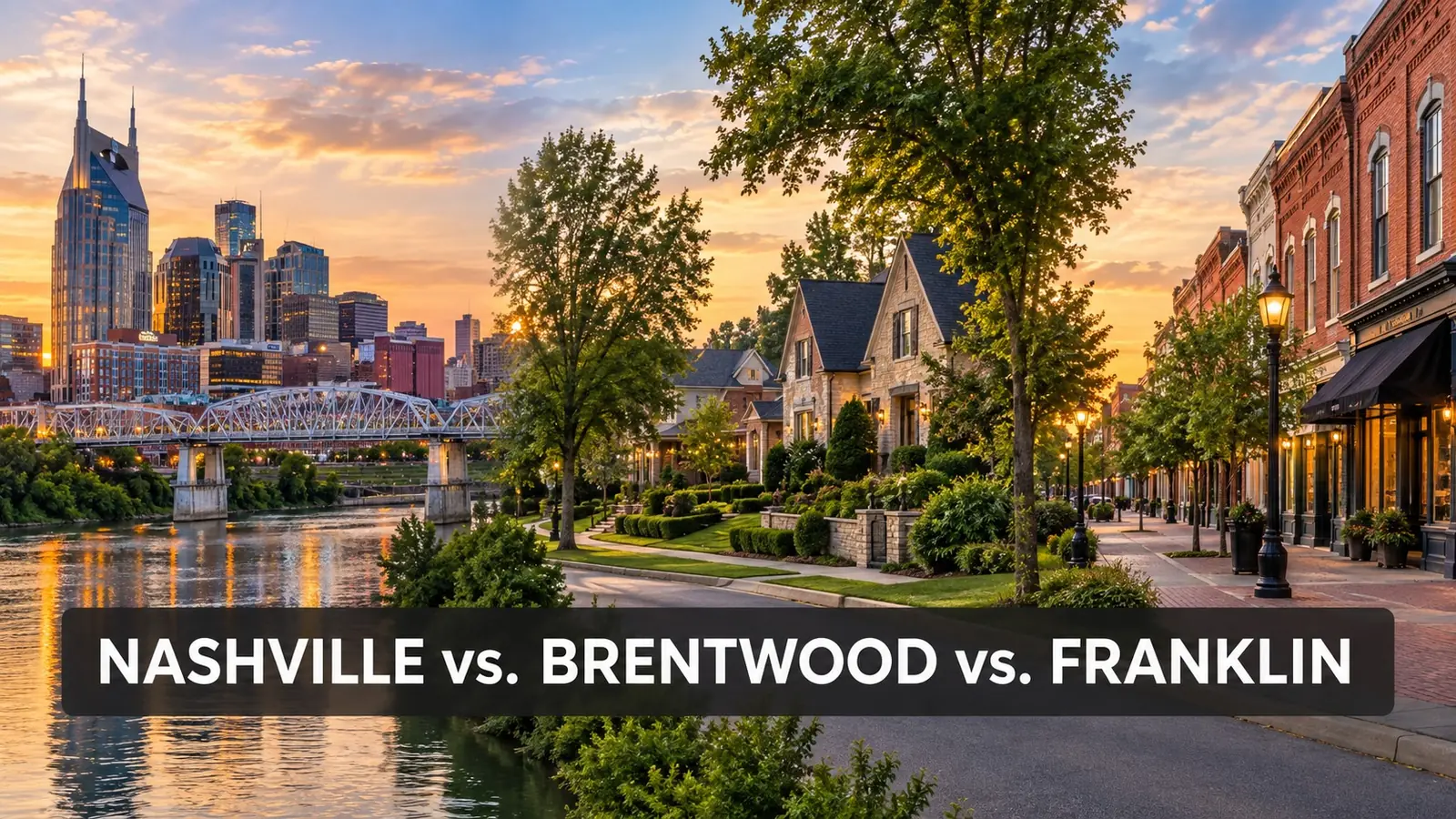
Nashville vs. Brentwood vs. Franklin: Where Does Your Budget and Lifestyle Fit Best?
Nashville is usually the most flexible choice for buyers who want more housing types and closer access to the urban core. Brentwood is the most expensive and primarily residential option. Franklin sits between them, combining a recognizable downtown, suburban neighborhoods, and a broader price range than Brentwood. Your best fit depends on budget, commute destination, and the kind of ordinary week you want.
Last updated: September 9, 2026
This comparison covers properties within Nashville-Davidson County, the City of Brentwood, and the City of Franklin. ZIP codes and mailing addresses do not always match city limits, so confirm taxes, services, and jurisdiction for each specific property.
Local perspective: This guide includes local real estate research and analysis from Harley Pope with Pope Real Estate Group at The Baker Brokerage.
The short answer: which city fits which priority?
Choose Nashville when location flexibility, neighborhood variety, or a shorter trip to an in-city destination matters more than maximizing lot size. Nashville offers the widest mix of condos, townhomes, older detached homes, renovated properties, and new construction—but the experience changes dramatically from one neighborhood to another.
Choose Brentwood when you have a higher budget and want a predominantly residential setting with larger-home and larger-lot options. The city reports that about 90% of its land is zoned residential, and some residential zoning districts require estate-scale lots. That development pattern is a major part of Brentwood’s appeal, but it also limits lower-priced entry points.
Choose Franklin when you want a suburban home base with its own downtown identity and more housing variety than Brentwood. Franklin includes historic areas, established neighborhoods, newer communities, townhomes, and the Cool Springs employment and commercial corridor. It is farther south than Brentwood, so a downtown Nashville commute deserves a real-world test.
How far does the same housing budget go?
The price gap is substantial, especially between Nashville and Brentwood. Redfin’s city-level data for the three months ending July 2026 reported median sale prices of about $480,000 in Nashville, $870,000 in Franklin, and $1.4 million in Brentwood. Those medians are directional markers, not quotes for what every neighborhood or property type costs.
| Budget | Nashville | Franklin | Brentwood |
|---|---|---|---|
| About $500,000 | Meaningful choices, but location, condition, size, and property type will trade against one another | Possible, with a heavier focus on condos, townhomes, smaller homes, or selected older properties | Limited and atypical; attached housing or unusual property circumstances may account for many options |
| About $750,000 | Broader detached-home choices, though highly sought-after neighborhoods can still require compromises | A workable search in multiple segments, with tradeoffs among age, size, lot, and proximity to downtown Franklin | Still an entry-level search relative to the citywide market |
| About $1 million | Strong buying power across many parts of the county, including some premium neighborhoods and larger homes | Meaningful flexibility, but newer, larger, or especially well-located homes may exceed the budget | Possible, but buyers should expect a narrower field than in Nashville or Franklin |
| $1.5 million and above | Luxury options vary from urban condos to renovated homes and larger properties farther from downtown | Access to a substantial luxury market, including newer construction and larger homes | Much closer to the center of the market, though estate properties and new construction can climb far higher |
These examples describe how a search may be shaped, not what will be available on a particular day. A citywide median can also mislead. Nashville’s downtown condos and outer-county detached homes are not one interchangeable market; neither are historic Franklin, Cool Springs, and newer fringe communities. Brentwood’s older homes and new luxury construction can produce very different price-per-square-foot results.
If Franklin and Brentwood are your finalists at the upper end of the market, this closer look at Franklin versus Brentwood’s luxury markets goes deeper into their differences.
Nashville: the widest range of locations and housing styles
Nashville works best for buyers who want to build the search around a specific workplace, neighborhood rhythm, or city amenity. The county contains dense urban districts, walkable neighborhood centers, postwar subdivisions, large-lot pockets, and newer suburban-style development. That variety creates more ways to solve a budget—but it also makes “Nashville” too broad to evaluate as one lifestyle.
The practical advantage is optionality. A buyer may accept a condo to stay near downtown, choose an older detached home in an established neighborhood, or move farther from the core for more space. The right choice depends on which compromise improves daily life rather than which Nashville ZIP code sounds most impressive.
Nashville also offers the strongest potential for a multimodal routine in selected areas. Metro is investing in transit, sidewalks, signals, and street improvements through its Choose How You Move program, but buyers should evaluate the infrastructure that exists at the actual address today. Sidewalks, transit access, and bike connections vary significantly by neighborhood.
Nashville may fit you if:
- Your job, clients, or regular destinations are in Davidson County.
- You want the broadest choice of attached and detached housing.
- You value proximity to restaurants, entertainment, universities, hospitals, or major employment centers.
- You are willing to compare neighborhoods individually instead of treating the entire city as one market.
The tradeoffs
- Two homes at the same price may offer radically different space, condition, parking, walkability, and commute patterns.
- Urban convenience can mean smaller lots, denser development, or more activity nearby.
- Property taxes, services, and neighborhood infrastructure should be checked address by address.
Brentwood: a higher-cost, predominantly residential market
Brentwood is the clearest fit when the buyer’s priority is a lower-density residential environment and the budget can support it. The City of Brentwood reports that approximately 90% of its 42 square miles is zoned residential. Its zoning also includes agricultural-residential areas with three-acre minimum lots, helping explain why the city has fewer compact or entry-priced housing options.
Brentwood’s location between Nashville and Franklin can be valuable for a household whose weekly destinations are split between Davidson and Williamson counties. But “Brentwood” on a mailing address is not enough. Some properties with a Brentwood ZIP code sit outside the City of Brentwood, which can affect taxes, services, and other property-specific details.
Brentwood may fit you if:
- Your budget is comfortably aligned with a market whose recent citywide median was about $1.4 million.
- You prefer detached homes, established residential neighborhoods, and larger-lot possibilities.
- You regularly travel both north toward Nashville and south toward Cool Springs or Franklin.
- You do not need a traditional downtown district to anchor everyday life.
The tradeoffs
- A buyer near $1 million may still face a narrower selection than expected.
- Lower-density development generally means driving for more daily trips.
- Large homes and lots can carry higher maintenance, insurance, utility, and improvement costs even when the local tax rate looks favorable.
Franklin: suburban range with a distinct downtown center
Franklin offers the most obvious middle path: its own historic center, substantial suburban development, and a price range that is wider than Brentwood’s but generally above Nashville’s citywide median. The original 16-block Franklin Historic District was placed on the National Register of Historic Places in 1972, and that preserved core still gives the city an identity separate from Nashville.
Yet Franklin is not only its downtown. A home near Main Street, a townhome near Cool Springs, an established subdivision west of I-65, and newer construction near the city’s edge can create completely different routines. Buyers should decide whether “Franklin” means walkable access to the historic core, proximity to employment and shopping, a particular housing style, or simply a Williamson County address.
Franklin may fit you if:
- You want a suburban base with a recognizable downtown and civic center.
- Your work or weekly routine is concentrated in Franklin, Cool Springs, or southern Williamson County.
- You want more housing-type and price variety than Brentwood typically offers.
- You can accept a longer or less predictable trip to central Nashville.
The tradeoffs
- The citywide median remains substantially above Nashville’s.
- Historic character, newer construction, lot size, and easy I-65 access each carry different price premiums.
- Growth and road construction can change the feel of a route, so commute testing matters.
Commute: test your real Tuesday, not a perfect Sunday drive
Your destination matters more than the city name. Someone commuting to Cool Springs may find Franklin or Brentwood more convenient than many Nashville neighborhoods. Someone working near downtown, Vanderbilt, the airport, or West Nashville could reach a different conclusion.
Brentwood sits north of Franklin along the I-65 corridor, so it generally starts with the geographic advantage for trips into central Nashville. Franklin adds distance and additional interchanges. Nashville may reduce the number of miles, but crossing the county at peak time can still be frustrating. Metro’s own downtown mobility planning identifies congestion as an issue and is developing traffic, transit, walking, and biking improvements.
Before making an offer, test the route from the actual property to your actual destination at the time you normally travel. Repeat it on a weekday. Then test the other trips that make up real life: groceries, appointments, activities, airport runs, and the people you see most. That is the Tuesday Test—the house should support the life you will actually live there.
Property taxes: compare the bill, not just the rate
Williamson County’s lower tax rates do not automatically make a Franklin or Brentwood home cheaper to own. Tennessee taxes residential property on 25% of appraised value, then applies the relevant county, city, and any other applicable rates. Because home values differ sharply among these cities, a lower rate on a more expensive house can still produce a meaningful bill.
For reference, Nashville’s official 2025 rates were $2.814 per $100 of assessed value in the Urban Services District and $2.782 in the General Services District. Franklin lists a city rate of $0.296 per $100 of assessed value, while Brentwood lists a city rate of $0.29; Williamson County and other applicable charges must be added. Rates can change annually, and boundaries matter.
The safest comparison is to request the current tax record for each property and verify whether the address is inside the municipality. The Tennessee Comptroller’s calculation guide explains the statewide formula.
Use this decision order before choosing a city
Start with the life requirement, then work backward to the location. A buyer who starts with a city name can overlook a better-fitting neighborhood—or stretch the budget for a label that does not improve daily life.
- Set a comfortable total monthly cost. Include principal, interest, taxes, insurance, HOA fees, utilities, and a realistic maintenance allowance.
- Map the three destinations you visit most. Work is only one part of the week.
- Choose your non-negotiable housing traits. Decide whether lot size, walkability, age, condition, main-level living, garage space, or square footage matters most.
- Test real routes. Drive them when you would normally travel.
- Compare three actual homes. One in each city will reveal more than a generic city ranking.
- Verify property-specific details. Confirm boundaries, taxes, utilities, HOA restrictions, flood information, and any planned projects affecting the property.
Relocating from outside Tennessee? The broader guide to Nashville, Franklin, Brentwood, and Spring Hill can help you decide where to begin before narrowing the search to these three.
Frequently asked questions
Is Nashville cheaper than Franklin and Brentwood?
At the citywide level, yes. For the three months ending July 2026, Nashville’s reported median sale price was about $480,000, compared with about $870,000 in Franklin and $1.4 million in Brentwood. Individual neighborhoods and property types can depart significantly from those figures.
Can I buy in Brentwood for under $1 million?
It is possible, but the selection is typically narrower and may include attached properties, older or smaller homes, homes needing updates, or properties outside the city limits that use a Brentwood mailing address. Confirm the jurisdiction before assuming the home receives City of Brentwood services or tax treatment.
Does Franklin have a better commute than Nashville?
Not as a universal rule. Franklin can be the more convenient choice for Cool Springs or southern Williamson County destinations. Nashville may be more convenient for an in-city job, but cross-town congestion can erase a simple mileage advantage. Test the exact route at your normal travel time.
Which city offers the most walkable lifestyle?
Nashville has the greatest number of distinct urban and neighborhood-center options, while downtown Franklin offers a concentrated historic district. Most of Brentwood and much of suburban Franklin and Nashville still require a car for daily errands. Walkability must be evaluated at the property level.
Which city gives me the most house for my money?
Nashville generally offers the broadest ways to stretch a moderate budget, but “more house” depends on location and condition. A buyer may get more square footage farther from the urban core, while a smaller home in Franklin or Brentwood may better support the desired routine. Compare total ownership cost and daily fit, not square footage alone.
Are property taxes lower in Franklin and Brentwood than Nashville?
The published local rates are lower, but the final bill depends on assessed value and every rate applicable to the address. Since Franklin and Brentwood home prices are generally higher, compare actual tax records rather than rates in isolation.
Should I choose the city before choosing a neighborhood?
Use the city to narrow the search, but make the final decision at the neighborhood and property level. Nashville, Franklin, and Brentwood each contain meaningful differences in housing, access, lot size, age, and daily convenience.
About Harley Pope
Harley Pope is a Middle Tennessee Realtor with Pope Real Estate Group at The Baker Brokerage. He helps buyers and relocating clients compare Nashville, Franklin, Brentwood, Spring Hill, Dickson County, and other communities based on housing, budget, location, and the life a move is meant to support. You can also view Pope Real Estate Group’s business profile and client reviews.
Compare the homes, routes, and real monthly numbers
A city comparison becomes useful when it is tied to actual properties. Contact Harley and Victoria Pope with Pope Real Estate Group at The Baker Brokerage to build a side-by-side Nashville, Brentwood, and Franklin home tour around your budget, commute, and Tuesday Test.