
Houston vs Nashville Cost of Living
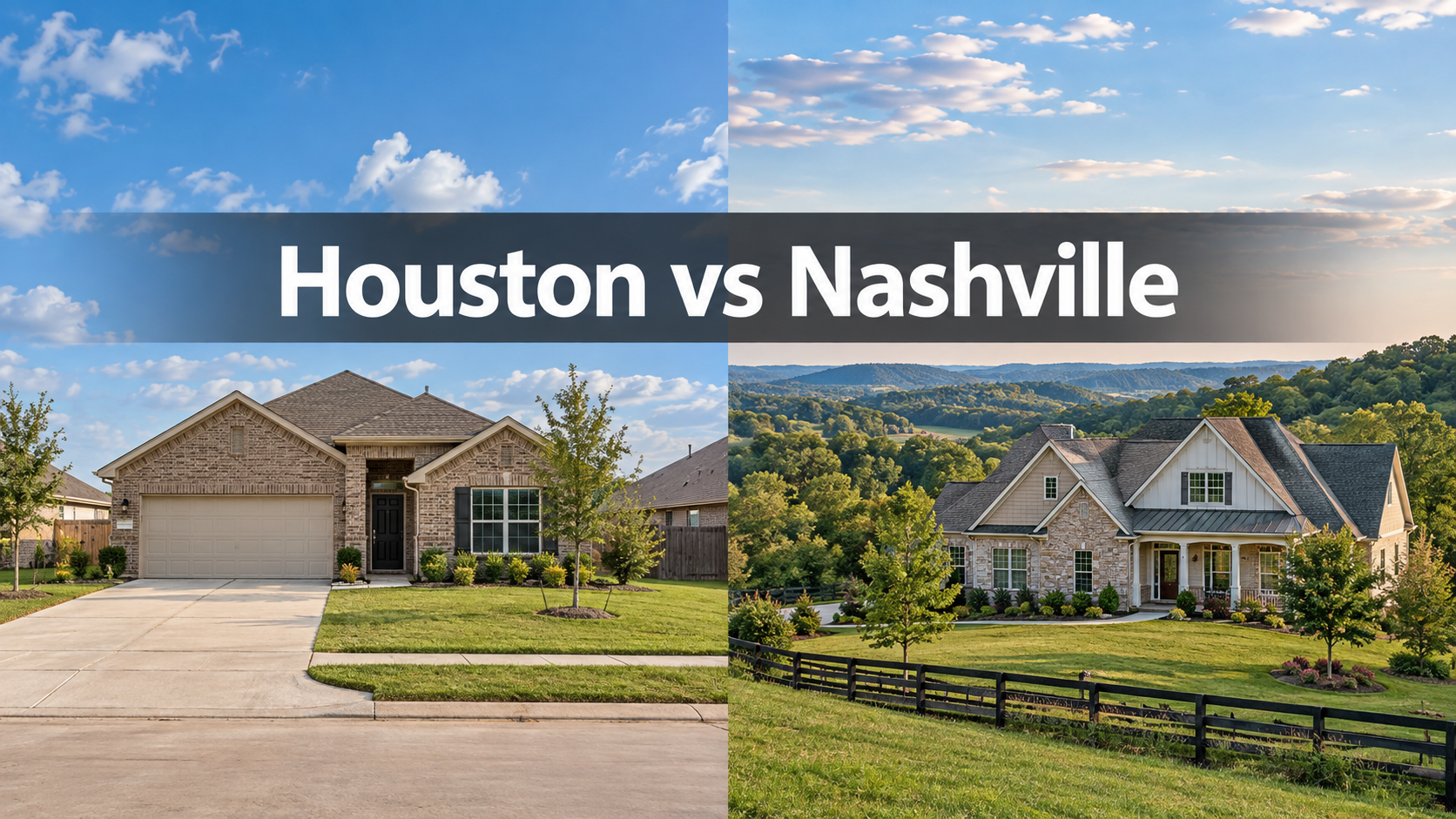
Houston vs Nashville cost of living is not a one-number comparison. Housing, taxes, insurance, transportation, and the kind of property you choose can change the answer by far more than groceries or gas. In general, housing prices can overlap, but Houston property taxes, flood and wind exposure, insurance, and vast commute patterns create a different monthly budget. The useful question is not simply which city is cheaper. It is what your same income and housing budget would let you do differently.
Last updated: September 19, 2026
This comparison uses the latest available public benchmarks, including U.S. Bureau of Economic Analysis regional price data, U.S. Census Bureau housing data, and current state tax guidance. It is a planning guide, not a promise about a particular home or household. I’m Harley Pope with Pope Real Estate Group at The Baker Brokerage, and I help people compare Nashville with the surrounding Middle Tennessee communities where their budget, commute, and everyday priorities may fit better.
Houston vs Nashville cost of living at a glance
Houston and Nashville both offer strong employment centers and broad suburban choices, but Houston is much larger, flatter, and more exposed to coastal weather. Nashville is smaller, hillier, and more expensive than its old reputation in many popular areas. A useful comparison starts with the full payment and the actual route to work.
| Cost question | Houston | Nashville and Middle Tennessee |
|---|---|---|
| Housing | Large supply and varied prices across an enormous metro | Less supply, with notable premiums in close-in and high-demand suburbs |
| State income tax | Texas does not impose an individual income tax | Tennessee does not tax earned personal income |
| Transportation | Very long drives are possible across multiple employment centers | Most households should plan around a car |
| Weather-related ownership costs | Flood, wind, hurricane, heat, humidity, and foundation exposure | Storm, hail, wind, drainage, and HVAC condition matter |
| Biggest budget trap | Ignoring tax, insurance, and flood details because the list price looks low | Assuming every lower-priced suburb produces an easy commute |
The table is directional. Before making a move, compare a real housing payment, a real insurance quote, your tax situation, and your likely weekly driving. That is more reliable than applying one national cost-of-living percentage to every household.
Housing is where the comparison usually becomes real
Houston can deliver substantial square footage at prices that surprise buyers from coastal markets. Yet the monthly payment may include high local property taxes, association costs, flood insurance, wind considerations, and long-distance commuting. A low price per square foot is not the same as low total cost.
Nashville often has less house for the same price in its most desired close-in locations, but surrounding counties expand the menu. The farther search may introduce acreage, wells, septic systems, two-lane roads, and more maintenance. Compare the complete property rather than the city labels.
Do not compare a source-city neighborhood with downtown Nashville and assume you have compared both markets. Nashville is one part of a larger region. Buyers often consider Davidson County, Williamson County, Rutherford County, Sumner County, Wilson County, Cheatham County, Maury County, and Dickson County. Each changes the mix of price, lot size, age, commute, taxes, and services. Start with the Nashville area guide, then use the broader directory of Middle Tennessee communities to compare realistic search zones.
Houston’s flatter development pattern and Nashville’s hills create different due diligence. In Houston, elevation, drainage, flood history, and foundation behavior can dominate. In Nashville, grading, runoff, retaining walls, crawl spaces, trees, and steep access can be equally important.

Compare monthly ownership cost, not just purchase price
A lower sale price does not automatically produce a lower monthly cost. The payment should include principal, interest, property taxes, homeowners insurance, mortgage insurance when applicable, association dues, and a realistic maintenance reserve. If the property has a pool, private road, acreage, detached building, older systems, or a septic system, add those costs too.
A Houston quote should account for county and special-district taxes, homeowners and flood coverage, roof and wind history, drainage, HVAC, and foundation. A Nashville quote should account for local taxes, roof, storm history, drainage, HVAC, moisture, trees, and any rural systems.
The cleanest exercise is to price three real options on the same day: one home close to Nashville, one farther out with more space, and one that represents the lifestyle upgrade you actually want. Ask a lender for estimated payments using the same down payment and rate assumptions. Then get insurance estimates before treating any option as affordable.
Taxes can change take-home pay, but they are not the whole budget
Texas and Tennessee both avoid a broad tax on individual wage income. Houston’s property-tax structure can be a major difference, depending on location and exemptions. Tennessee buyers may see lower property taxes on a comparable home, but should still compare sales tax, insurance, and transportation.
Tennessee currently has no state income tax on earned income. That may create a meaningful difference for a household coming from a state that taxes wages. The exact benefit depends on income type, deductions, residency timing, and current law, so a CPA should calculate it. Also remember that governments fund services differently. Sales taxes, property taxes, vehicle costs, insurance, and local fees still belong in the comparison.
A useful approach is to build an annual side-by-side worksheet with five lines: state income tax, property tax, insurance, commuting, and housing maintenance. Divide the total by twelve. That monthly number is often more honest than a headline about taxes.
Transportation and commute can erase a housing win
Houston’s scale and multiple job centers make the right side of town essential. A cross-metro move can produce an exhausting commute even when the home looks like a great value.
Nashville is smaller, but traffic concentrates on fewer corridors. If the job is downtown, at the airport, in Cool Springs, in Clarksville, or elsewhere, the search map should change. The cheapest county is irrelevant if the route breaks the week.
For Nashville-area shopping, identify the destinations that will repeat every week, not just the office. Map work, childcare, medical appointments, airport trips, family, worship, recreation, and the grocery store. Then test the routes during the hours you would actually drive. The Nashville neighborhood search guide explains how to organize the search around budget, commute, and home style instead of starting with a long list of place names.
Utilities, climate, and insurance deserve their own line items
Houston buyers are accustomed to heat and humidity, but hurricane wind, intense rainfall, flood zones, drainage infrastructure, and insurance can reshape ownership. The absence of a flood claim does not remove future risk.
Nashville still has heat, humidity, heavy rain, and severe storms, but not Houston’s coastal hurricane exposure. Buyers instead may face more hills, trees, freeze events, and drainage patterns that vary sharply from one lot to the next.
In Middle Tennessee, buyers should pay attention to roof age, drainage, grading, trees, HVAC condition, storm exposure, and any mapped flood risk. Utility history can be more useful than a seller’s general description of efficiency. Ask for available bills, review the inspection carefully, and obtain an insurance quote during the contingency period. Never assume two homes with the same price will cost the same to operate.
What daily life feels like after the move
Houston offers immense restaurant, cultural, medical, and employment networks spread across a broad region. Nashville feels smaller and may be easier to understand, yet its amenities and employers are not evenly distributed.
A move can shorten some kinds of trips while reducing variety or changing access to major airports and specialized services. Decide what you use weekly, monthly, and only occasionally. Do not pay a daily commute cost to optimize a rare trip.
This is where I use what I call The Tuesday Test. Picture a normal Tuesday six months after closing. Where do you wake up? How long does the school or work run take? Can you get to the places you use without turning every errand into a project? Do you have the outdoor space, office, garage, walkability, or privacy you expected? A house should make ordinary days better, not only look impressive during a weekend showing.
How to compare neighborhoods without steering yourself wrong
Choose objective factors before choosing locations. Write down your maximum payment, acceptable drive time, required bedrooms, parking needs, lot preference, tolerance for renovation, and any nonnegotiable property features. If schools matter, use official district boundaries and your own research rather than labels such as “good” or “bad.” If safety matters, review current public data and visit at the times you expect to be there.
Then rank the tradeoffs. A closer-in home may be smaller or older. A newer home may be farther from the destinations you use. More acreage may mean more maintenance or a private wastewater system. A condominium can reduce exterior upkeep but add dues, rules, and financial-document review. There is no universal winner. There is only a better fit for the life and budget you are actually bringing to Tennessee.
A practical relocation plan from Houston to Nashville
- Set a complete monthly ceiling. Include taxes, insurance, dues, utilities, maintenance, and transportation.
- Choose three search zones. Use one closer-in area, one middle-distance option, and one farther-out value or space option.
- Plan a decision trip. Drive the routes, tour different housing types, and spend time in each area during ordinary hours.
- Prepare financing early. An underwritten preapproval and clear funds plan make the search more useful.
- Quote insurance before committing. Property-specific risk and rebuilding cost matter more than a broad state average.
- Coordinate the move and purchase. Decide whether your current home must sell first, whether temporary housing is acceptable, and how much overlap you can carry.
For broader planning, start with the Middle Tennessee relocation guide. To compare Nashville with other source markets, review the Atlanta comparison, Chicago comparison, and Los Angeles comparison.
For the logistics, use the Houston-to-Nashville relocation guide. If an agent in Houston is helping coordinate the move, the Houston Realtor referral guide explains how I protect the existing relationship and handle the Middle Tennessee side. You can also review the out-of-state home-buying guide before a decision trip.

Who may prefer Houston, and who may prefer Nashville?
Houston may fit someone who values its scale, energy and medical employment, international connections, diverse housing supply, and established network, and who understands the region’s weather and tax structure.
Nashville may fit someone who wants a smaller metro, hillier and greener surroundings, different industry connections, and access to small towns or acreage without adding state wage tax.
The move may not make sense if it depends on an unrealistic commute, a tax estimate that ignores the rest of the budget, or the assumption that every Nashville suburb is inexpensive. It may make very good sense when it improves both the numbers and the normal week. Great homes make ordinary days better, and that is the standard worth testing.
Frequently asked questions
Is Nashville cheaper than Houston?
It can go either way. Houston may offer more square footage at a given price, while Nashville may compare favorably on property taxes and some insurance risks. Use the full monthly payment and property-specific quotes.
Does Tennessee have a state income tax?
Tennessee does not currently tax earned personal income. Ask a qualified tax professional how a move would affect wages, business income, investments, residency, and filing obligations.
Are Nashville property taxes low?
Property taxes vary by county, city, assessed value, and exemptions. Compare the actual tax record for each property rather than relying on a statewide ranking.
Should I rent before buying?
Renting can be reasonable when employment, timing, or location is unsettled. Buying may fit when you understand the region, expect to stay, and have enough cash for closing, reserves, and ownership surprises. The answer is personal, not automatic.
How far outside Nashville should I search?
Start with your real recurring destinations and maximum drive time. A map radius is less useful than route testing during your normal travel windows.
What should I do on a relocation visit?
Tour different property types, drive the same corridors at different times, check daily conveniences, meet a lender when useful, and leave with a ranked short list rather than trying to see everything.
Can my current Realtor refer me to a Middle Tennessee agent?
Yes. I regularly work with referring agents, keep communication clear, and protect the client relationship while handling the Tennessee search. See my referral partner information for the process.
About Harley Pope
Harley Pope is a Middle Tennessee Realtor with Pope Real Estate Group at The Baker Brokerage. As a lifelong Middle Tennessee local, he helps buyers and relocating households compare Nashville with surrounding communities through practical conversations about housing, land, commute, condition, and everyday life. His work is focused on helping clients make a confident decision without overselling a location or hiding the tradeoffs.
If you are comparing Houston with Nashville, Harley and Victoria Pope can help you turn the cost question into a property-specific plan. Contact Pope Real Estate Group at The Baker Brokerage to compare areas, prepare a decision trip, or coordinate with your current Realtor. Call or text Harley at 931-629-4836.